Everything You Say Yes To

Everything You Say Yes To
Everything you say yes to is saying no to something else.
In fact, everything you say no to is also saying no to something else. And not just something else. But to almost everything else.
Every minute of our short time on earth is a rejection of millions of possible lives in favour of one. There are effectively infinite things we could be doing at any given moment, and only one thing we actually are doing.
I am writing this essay whilst also not doing an infinite list of amazing things and an infinite list of terrible things that I could be doing right now. Life is just a long string of an infinite set of nos.
Finitude and Choice
There is a classic story about rocks, pebbles and sand and trying to fit them all in a jar. If you put in the sand and the small pebbles first, you won’t have space for the rocks. But if you place the rocks first, and only then add the smaller things, you should be able to fit in the pebbles and the sand as well. The usual life advice is clear enough: prioritise the big things and the small things will take care of themselves.
I read an article recently that pushes back on this idea. The entire metaphor assumes there is a finite number of rocks. But real life doesn’t work that way. There is no end to what we might reasonably consider the rocks - the important stuff. Forget the pebbles and the sand, there are more rocks in existence than the biggest jar in the world can contain.
So where does that leave us?
Every minute I spend with my kids is a minute I didn’t spend exercising, giving charity, calling my mother, learning Torah, answering work emails, or curing cancer. How does the jar story help me say no to the millions of rocks that I will never get to?
How should we relate to this reality?
Prioritising Isn’t Enough
One option is to listen to the parable despite its flaws and just prioritise as best as we possibly can. To push off all the big things and attack the really really big things.
The problem is that some people end up experiencing life as a long series of embarrassing rejections. The way you might feel if you kept turning down a dinner invitation because something kept coming up.
Each conscious no feels heavier than the last. Every time you think of the things you missed out on leaves a residue of discomfort. You’re doing things that matter, yet a persistent voice lingers, that you missed out on some other really important thing or things you could have done.
Living like this doesn’t bring clarity. It produces a constant low-grade guilt. Not because your choices are wrong, but because the framework for making them is. Treating every no as a failure quietly erodes the meaning of the yeses you can make.
Saying Yes to Everything
An alternative plan of action is to live life trying to complete the entire series of important stuff to do. Decide that you’re no longer going to accept your limitations. We all know the line. “If you want something done. Ask a busy person.” So you say yes to everything and then off you go.
Ok so you won’t sleep…But you’ll get to visit your mother, learn the daf, take care of the kids, wash the dishes, attend the shul meeting, and cure cancer - all before going to bed.
Let me know how that goes…
The more nos you try to suppress, the more they assert themselves elsewhere. Exhaustion. Irritability. Resentment. The body always collects its debt.
Much productivity advice is built on the hope that with the right system or discipline, the jar will eventually expand. But for most people, most of the time, it doesn’t. Time is remarkably stubborn.
The Residue of Choosing
What both strategies have in common is a refusal to accept the underlying truth: a finite life is made of irreversible exclusions. There is no arrangement clever enough, and no mindset generous enough, that allows you to say yes to everything that matters.
The problem isn’t that we choose badly. It’s that we want our choices to come without residue. Without the quiet grief of everything they exclude. But that grief isn’t a sign of failure. It’s the price of taking any path at all.
Maturity then, isn’t learning how to fit more into the jar. It’s learning how to live without demanding innocence from your decisions. Not every no needs to be redeemed. Most nos are simply the cost of a life actually being lived.
So what does it look like to live well inside constraint?
One part of the answer is internal. Learning to be okay with doing something rather than everything we want to do. Not as a coping mechanism, but as a form of maturity. A finite life cannot be lived without costs. Wanting it to feel otherwise is what creates so much of the friction.
Once you let go of the fantasy of expansion, something surprising happens. Life becomes less about adding and more about swapping. If something new is coming in, something else is going out. Not because you failed, but because that’s how finite containers work.
This alone makes the nos easier to live with. They stop feeling like personal shortcomings and start looking like structural facts.
Still, that truth on its own is hard to inhabit.
It’s one thing to accept, intellectually, that a finite life is made of exclusions. It’s another to wake up each morning and feel the weight of everything you are not doing, not choosing, not becoming. If every choice requires a moral spreadsheet - children versus learning, exercise versus kindness, presence versus productivity - you might end up back where you started: paralysed, tired, and strangely detached from the life you’re supposedly optimising.
Acceptance can easily slide into resignation, or worse, quiet bitterness.
Choosing Your Breakfast Plate
Here’s where I present a different framing that has really helped me.
Instead of asking whether each decision is the best possible yes, ask whether it fits your values.
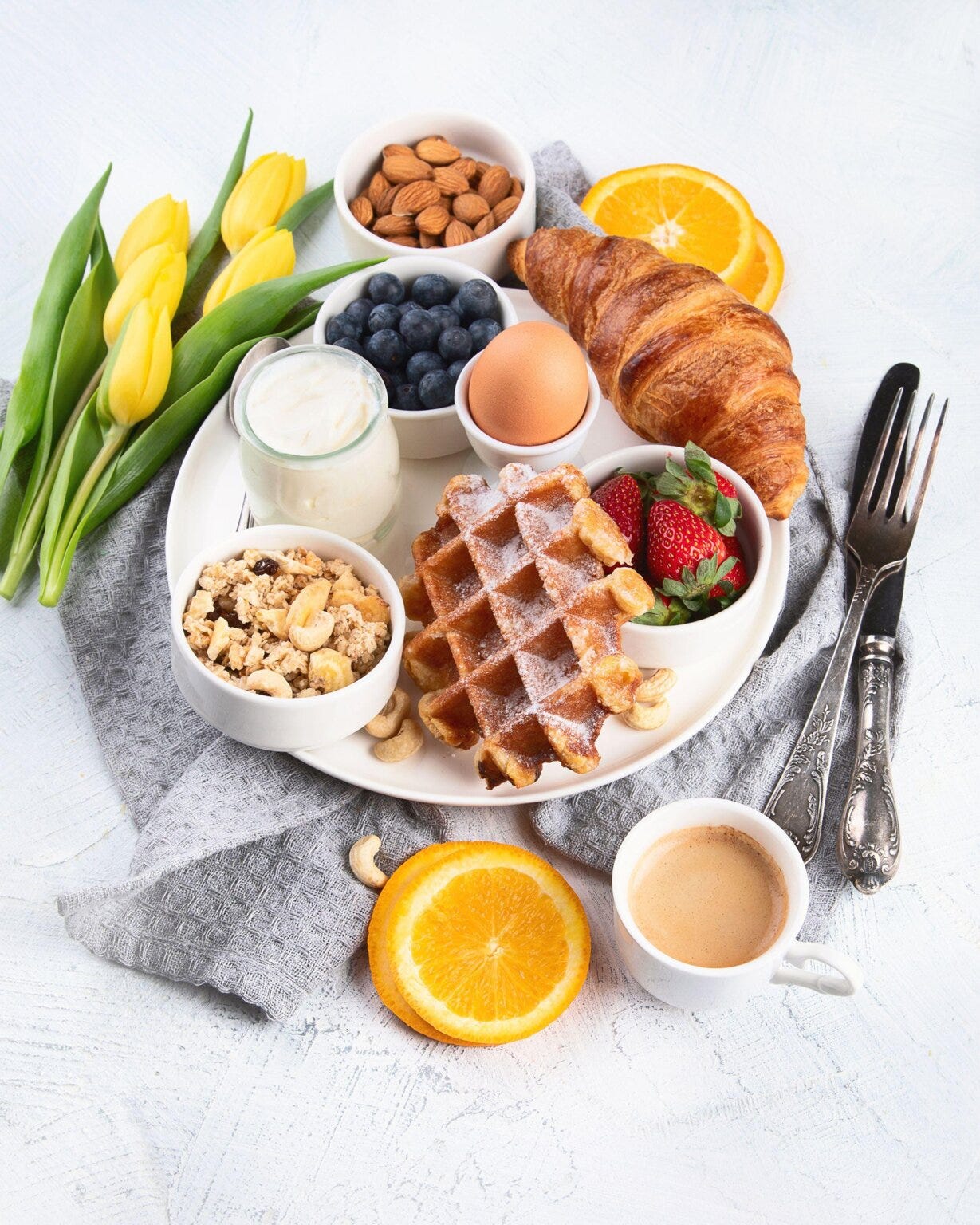
A more fitting metaphor than the jar, given the almost infinite number of options, might be a hotel breakfast. When I think about the ones I’ve experienced, it is often the case that there are hundreds of possible choices of things to eat. Inevitably, that means hundreds of nos.
You’re limited by your stomach capacity and by what you can physically carry back to the table. So you don’t try to eat everything on offer. That would be absurd. You fill one plate. And once the plate is full, the question isn’t what did you reject? but whether what you’ve chosen belongs together on the plate. I might come back and fill up another plate of different combinations in a few minutes’ time but my concern during plate number one is whether this looks like a suitable combination for this moment now. Whether it makes sense as a plate. Whether it reflects what you actually want to eat this morning. At the first attempt anyway.
You might swap the croissant for eggs. You might feel a flicker of regret passing up the pancakes. But you don’t experience the untouched buffet as a personal failure. You experience it as abundance you were never meant to exhaust.
Living by values works the same way. Values don’t eliminate nos. They organise yeses. They turn decisions from endless calculation into coherence. The question shifts from “What am I missing?” to “Does this belong on my plate now?”
Importantly, none of this is permanent. A plate isn’t a life sentence; it’s a moment. What doesn’t belong together now may belong perfectly well in your second or third plate. The point isn’t to reject entire categories forever, but to decide what fits this plate, this morning, this season of life.
Seen this way, the grief of exclusion doesn’t disappear. But it softens. It becomes less about loss and more about privilege. The privilege of being able to choose something at all right now.
A life well lived isn’t one that says yes to everything that matters. It’s one where the yeses make sense together and the nos are no longer treated as accusations.
That may be as close to peace as a finite life gets.