12ish Rules For Life
What I Learned From Writing Down What I Already Knew

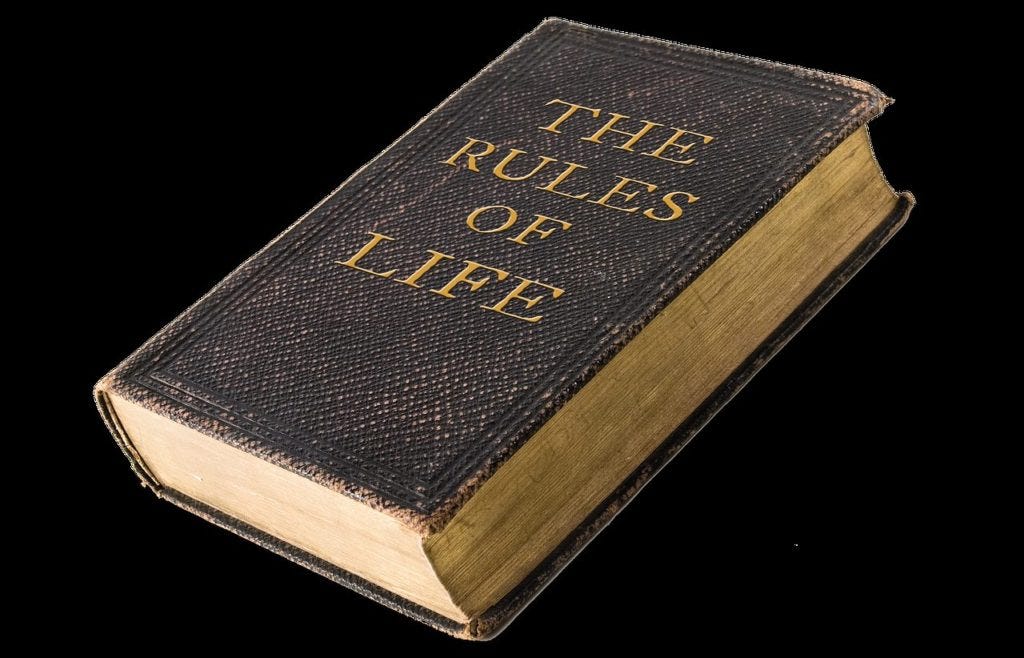
In February 2021, after reading Jordan Peterson’s 12 Rules for Life, I decided to try a simple exercise.
I sat down and thought about what rules I actually want to guide my life.
Not Peterson’s rules.
Not a set of generic (and often trite), life goals.
Not fluffy aspirations.
Not unattainable outcomes.
I didn’t want rules that sounded good as a bumper sticker. I wanted rules that reflected the things that mattered to me, even if they become inconvenient.
I wanted the list to be things I could keep at the back of my mind when making decisions. Things I could return to periodically and ask a very plain question: am I living this way or not? Just a few rules to try and actually follow.
It took no longer than ten minutes to come up with them. I saved them in my phone’s notes and continued with my day.
Nearly five years later, I still love these rules. I’ve looked at them dozens of times. And I still find the exercise surprisingly grounding. It’s hard to say what the effect of an exercise like this has been. And the honest truth is that it’s been at least a year since I last had any conscious thought about the list. But my sense is that the ROI has not been insignificant.
This started as a journal entry, something I have done consistently inconsistently for a few years. I go through waves of journalling in some capacity more or less regularly. This entry from 2021 was similar to my others. Not loads of thoughts go into the input. It’s just a download of fleeting thoughts. It’s usually whatever pops in my head after a long day. But the ideas often linger. Not necessarily for long periods like months or even weeks. But just enough time for them to influence one or two of my next moves. And sometimes those moves trigger some other moves and so on…And then I look back and realize the start of some things I’ve done, go back to some random note I made on my phone.
The benefits of writing this random set of rules haven’t announced themself. It didn’t feel profound in the moment. Journal entries like this often feels almost trivial. More than a few times, I’ve considered deleting what I wrote because the words feel shallow. Writing sentences you already agree with, recording principles you’ve heard before. Why bother?
And yet, over time, a sample of the thoughts behind these rules somehow rise to the surface, unprompted and perhaps slightly earlier in the decision-making process than they may have done otherwise. They show up as gentle whispers.
For me, writing things down as notes or journals or whatever you want to call it has been one of the simplest ways those whispers get a bit louder.
Journaling reminds me of the feeling I had when I started using noise-cancelling headphones. Until you experience them, the appeal of it sounds marginal. From the outside it looks like an alternative form of what I am already doing. I already listen to things with headphones, how big can the incremental benefit of slightly crisper sound really be? It presented itself as an unnecessary upgrade on the current ‘does the job’ format.
Until I tried them. And then I never looked back.
In this case, journaling can look from the outside as an overindulgent version of thinking that is happening regardless. We are generally good at thinking. We do it all the time. I’m having those thoughts anyway so why should I write it down. What possible value could there be of doing the same thinking with a pen, at a slower pace? It seems inefficient at best and especially since I’m capturing so few of my actual thoughts. Just a tiny fragment of them, at one particular point in time. Does it even remotely represent my overall set of thoughts?
But then once you experience doing it for some period of time, it’s hard to remember what it was like to not do it. The gain isn’t something you actively notice; The same voices tug at you. The same inadequacies and insecurities colour your mind. But you bring a few of them to the surface and they somehow take on a new dimension.
I don’t think it changes who you are. I think it allows you to give form and structure to the millions of streams of consciousness which float around your inner world. I think it also changes which thoughts get first access to your attention. And often, that’s enough.
So here are my rules exactly as I wrote them five years ago. This is the first time I’m sharing them with anyone, anywhere. Genuinely.
Read them. Laugh at them. Ignore them. Or perhaps try the exercise for yourself…
1. I should prioritise my kids over work and other activities in my life
2. I should listen attentively and empathise with all people I come across
3. I should dedicate time every single day to learning Halacha and Gemara
4. I should be a positive voice for people around me
5. I should constantly be seeking opportunities to grow as a person - through reading and self-reflection
6. I should favour outcomes that lead to change or discomfort
7. I should focus on quality, slow consistency in order to advance in anything I care about
8. I should always take responsibility, even if it’s not entirely in my control
9. I should find ways to take care of my physical and mental wellbeing
10. I should spend some minimal amount of time every day being mindful of God
I don’t revisit these to judge myself. I revisit them to orient myself.
Looking at the rules now, the list is uneven. Some of the rules are concrete and measurable, others vague enough to be almost unhelpful. A few sit comfortably together; others pull in different directions. There are days when prioritising my kids clashes with work, or when slow consistency feels like an excuse for not pushing harder. I don’t follow all of them well, and I never have. Some of them I probably fail at more often than not.
But that’s kind of the point. They weren’t written to be optimal or comprehensive, and they certainly weren’t written to make me feel good about myself. They were written to reflect what I actually care about when I strip things back. As a set, they don’t tell me what to do. They just make it slightly harder to pretend I don’t know what matters.
Over time, the rules stopped feeling like rules at all. It’s more like just a handful of considerations that I would like to lean on when moving through life.
If you’ve never done something like this, I’d strongly recommend it: sit down, think hard or not so hard, and write a small set of rules you’re willing to live with and live by.
They don’t need to be impressive.
They just need to be honest.